Whether you are in a big pharma company, an emerging biotech, or a CRO, the reality is the same: we all rely on vendors. But simply hiring a vendor and hoping for the best doesn’t cut it anymore. Today, having a rock-solid oversight process and governance model isn’t just “nice to have” - it is survival.
You might be asking, “Why the sudden urgency?” The short answer is that the regulators have drawn a line in the sand.
The Regulatory Wake-Up Call
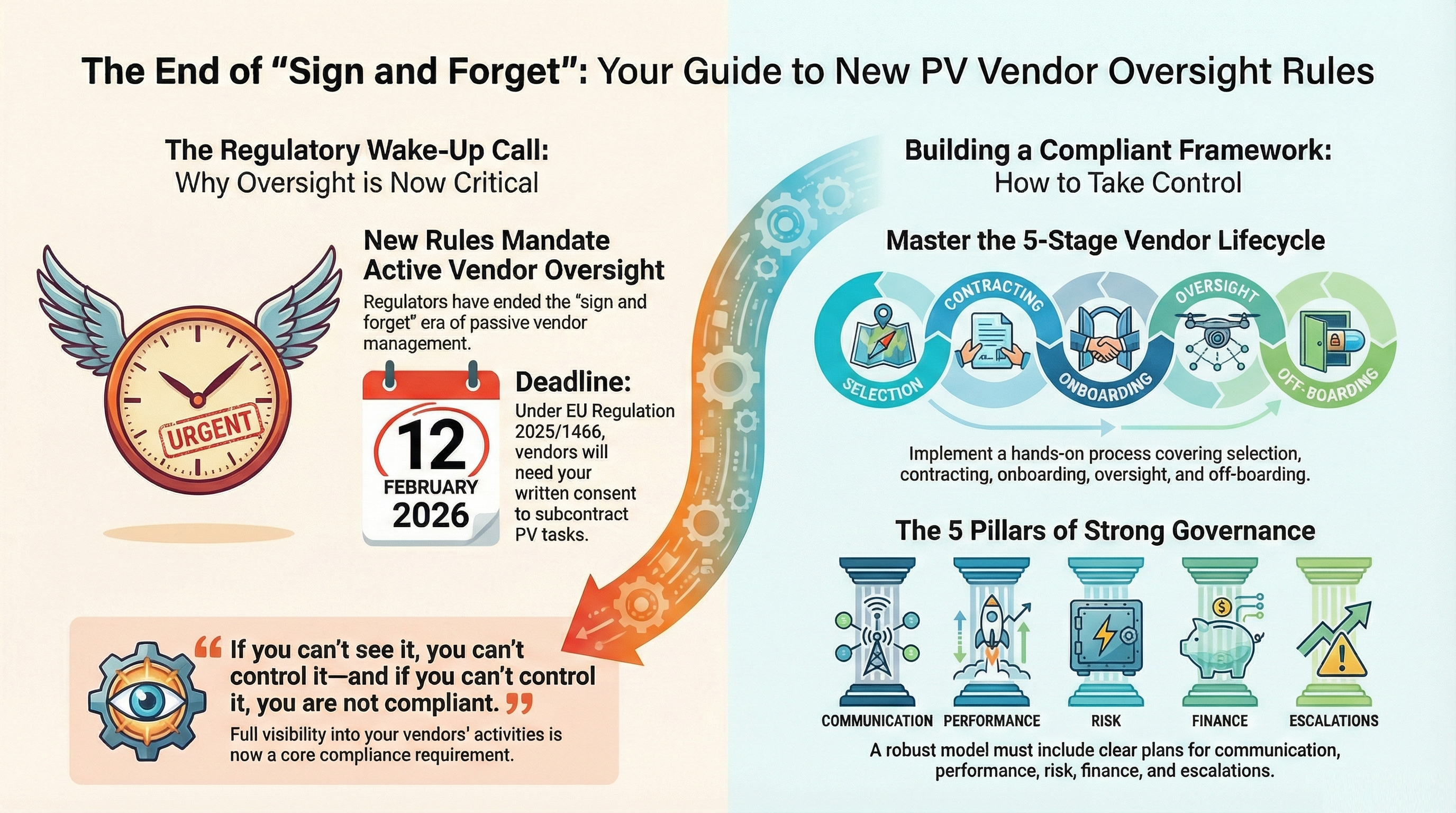
The landscape is shifting fast. The ICH E6(R3) guideline now explicitly mandates oversight for all third parties supporting clinical studies and projects. But the biggest shake-up comes from the EU. Recently, the EU published Regulation (EU) 2025/1466 (adopted July 2025), which significantly updates European Union pharmacovigilance (PV) rules by amending Regulation 520/2012.
Here is the part you need to pay attention to: Effective fully from February 12, 2026, the legal mechanics of subcontracting will change fundamentally. Under the new Article 6, third parties cannot subcontract any pharmacovigilance task assigned to them without the MAH’s written consent.
What Does This Mean in Practice?
Imagine your primary CRO wants to switch its literature screening provider or hire a local safety freelancer. Previously, they might have just done it. Now? They require your affirmative, written approval before that switch happens.
While the EU is tightening the contracts, ICH E6(R3) is broadening the scope to ensure sponsors have access to those contracts.
The convergence of these regulations signals the end of passive vendor management. Compliance is no longer about having a contract locked in a drawer; it is about active, documented, and continuous oversight. The regulators are effectively saying: if you can’t see it, you can’t control it and if you can’t control it, you are not compliant.
The Vendor Management Lifecycle: A Quick Refresher
To stay compliant, you need to be hands-on across the entire lifecycle:
- Vendor Selection: It starts with finding the right fit. You work with procurement and audit teams to perform IT and QA qualifications. Note: Regulation (EU) 2025/1466 now mandates that your audit must cover the complete quality system for all PV activities.
- Contracting: Once selected, legal gets involved to draft the CDA and MVA/MSA. This isn’t just paperwork; it defines roles, data privacy, payment terms, and audit rights. Remember, ICH E6(R3) mandates that sponsors must have access to these contracts.
- Onboarding: This is where the work begins. You grant system access and train the vendor team on your specific SOPs.
- Oversight: This is the most critical stage. You need a governance model to keep eyes on all subcontracted activities, meeting regularly to ensure KPIs are met.
- Off-boarding: When the relationship ends, you terminate the contract, revoke access, and meticulously document the handover process.
Building a Governance Model That Works
Strong governance isn’t just about avoiding regulatory fines; it’s about better cost management, risk mitigation, and operational efficiency. Your model needs to cover these five pillars:
- Communication Plan: Define the rhythm. How often are you meeting? Who is attending? Is it a quick status sync or a deep-dive review?
- Performance Monitoring: If you don’t measure it, you can’t manage it. Establish clear KPIs and metrics, and have a plan for when targets are missed or delayed.
- Risk and Issue Management: When things go wrong (and they will), how do you handle the risks and issues?
- Financial Oversight: Keep a close watch on the spend. Is everything staying within the approved budget?
- Escalation Matrix: Who do you call when a project hits a wall? Define a three-level escalation path based on severity so problems get solved fast.
The days of passive vendor relationships are over. With the new 2026 regulations looming, it’s time to dust off those governance plans and ensure you really know who is doing your PV work.
Thanks for reading.
😃
If you have any comments, feedback, or requests, please feel free to connect with me on LinkedIn. And if you liked this post, don’t forget to share it with your network!