Pharmacovigilance has long sat at the heart of patient safety, traditionally relying on structured processes and conservative risk management to detect and prevent adverse drug reactions. Today, Artificial Intelligence is fundamentally transforming PV operations-from automated case intake and triage using Natural Language Processing to machine learning algorithms identifying patterns across massive safety datasets.
However, introducing dynamic, learning AI systems into a highly regulated environment raises a critical challenge: How do we govern and validate these systems while maintaining compliance and patient protection? Because traditional regulations were designed for deterministic systems and manual processes, organizations must implement rigorous AI governance structures to prevent their AI from becoming an unacceptable regulatory “black box”.
Here is a deep dive into the foundations, challenges, and best practices for AI governance and risk management in pharmacovigilance.
The Evolving Regulatory Landscape
Regulators globally are raising the compliance bar for AI. The EU’s AI Act categorises AI systems according to their potential impact on health, safety, and fundamental rights. Pharmaceutical AI applications that serve medical purposes-such as diagnostic algorithms and clinical decision-support systems-are automatically classified as high-risk, triggering stringent requirements for data governance, algorithmic transparency, and human oversight.
Similarly, the European Medicines Agency (EMA) advocates a risk-based approach that assesses systems based on their potential for “high patient risk” (affecting patient safety) and “high regulatory impact” (substantially impacting regulatory decision-making). Meanwhile, the FDA has proposed a risk-based credibility assessment framework that evaluates an AI model based on its “context of use,” specifically examining the model’s influence on decisions and the real-world consequences of an incorrect output.
Defining Risk in AI-Enabled Pharmacovigilance
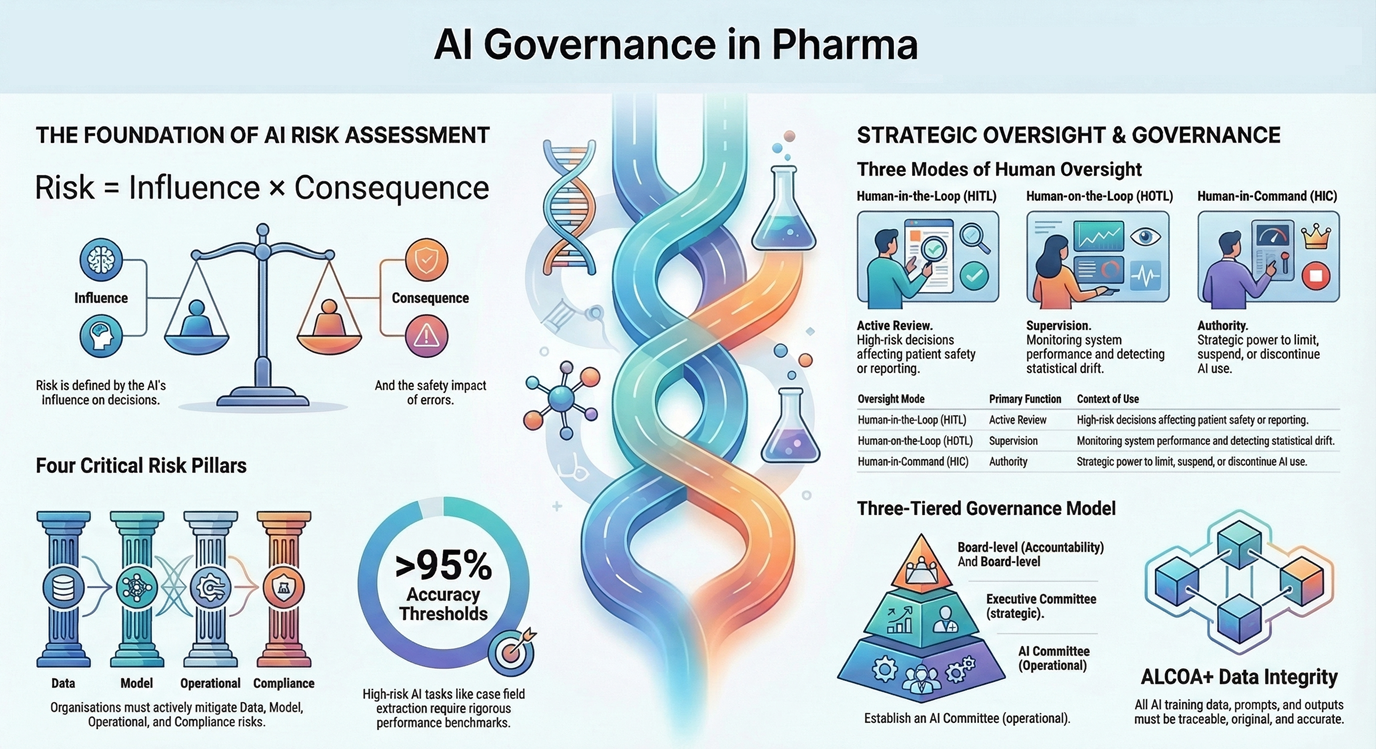
When deploying AI in PV, risk should not be assessed by how advanced or sophisticated the technology is, but rather by what happens when the technology is wrong. Risk in AI-enabled PV is fundamentally driven by two factors: the consequence of an incorrect output and the degree to which the AI system influences pharmacovigilance decisions.
AI introduces several unique risk categories that must be managed:
- Model Risk: Incorrect predictions, such as an AI system mistakenly categorizing a serious adverse event as non-serious.
- Data Risk: Poor-quality, incomplete, or biased data impacting model outcomes, such as missing safety signals due to unrepresentative training data.
- Operational Risk: System failures that disrupt critical PV workflows, like an automation tool failing to populate safety databases.
- Compliance Risk: AI decisions that lack explainability and cannot be justified during regulatory inspections.
Core Pillars of AI Governance
To navigate these risks safely, pharmaceutical companies and PV teams should build their AI strategies upon several core governance pillars:
1. Structured Oversight and Accountability
AI systems cannot be held accountable; humans must be. Organizations should clearly establish AI system owners, data owners, model developers, and quality assurance oversight. Legal experts increasingly advocate for a three-tiered governance framework:
- An AI standing committee of cross-functional specialists to handle operational issues.
- A strategic executive committee (including a Chief AI Officer and Chief Legal Officer) to approve significant projects and manage risks.
- Board-level oversight to enforce accountability and provide structured reporting.
2. Meaningful Human Oversight
Treating human involvement as a mere procedural checkbox can lead to “automation bias,” where human reviewers unconsciously defer to AI outputs because the system usually performs well. Effective oversight must be intentional and generally falls into three models:
- Human-in-the-Loop (HITL): A qualified human reviews AI outputs and has the authority to accept, modify, or reject them before they influence decisions.
- Human-on-the-Loop (HOTL): Humans do not intervene in every individual output but supervise system performance over time, intervening when anomalies are detected.
- Human-in-Command (HIC): Humans retain the ultimate authority to decide whether, when, and how an AI system is used, including suspending it if risks outweigh benefits.
3. Validation and Lifecycle Management
Traditional Computer System Validation (CSV) assumes fixed software behavior, but AI models continuously evolve. Therefore, the industry is shifting toward a risk-based Computer Software Assurance (CSA) approach, focusing validation efforts heavily on high-risk outputs that affect patient safety. Because AI systems can experience “model drift” (degradation in performance as real-world data changes over time), continuous validation is required, utilizing real-time monitoring and periodic retraining reviews.
4. Transparency, Explainability, and Data Privacy
Regulators increasingly expect “explainable AI” (xAI) outputs to support pharmacovigilance decisions. Explainability tools-such as SHAP (Shapley Additive exPlanations) or LIME (Local Interpretable Model-Agnostic Explanations)-help human reviewers understand the underlying logic and features the AI used to make a specific prediction.
Furthermore, data privacy remains paramount. While processing large, heterogeneous datasets is necessary for AI innovation, it must comply with regulations like the GDPR and HIPAA. Deploying AI requires dynamic, well-documented protocols for anonymization and data minimization, balancing the technical utility of data against the persistent risks of patient re-identification.
Artificial intelligence offers an unprecedented opportunity to modernize pharmacovigilance and proactively protect patient health. However, as the role of AI expands, leadership accountability becomes more concentrated, not less. By embracing a risk-based governance framework, maintaining rigorous human-in-command oversight, and insisting on explainability, PV teams can safely harness the power of AI while remaining strictly compliant with global regulatory standards.
Further Reading
For a deeper look at risk-based validation approaches for AI systems in Pharmacovigilance, you may find these articles useful:
• EU Perspective (ALCOA+ aligned validation strategy):
https://highondata.com/blogs/validating-ai-system-in-pharmacovigilance-pv-eu-ai-gmp/• FDA Perspective (risk-based validation approach):
https://highondata.com/blogs/validating-ai-system-in-pharmacovigilance-pv-fda/
😃
That’s all for now! Thanks for reading. Let me know what you think or what you’re seeing on your side of the PV + AI world.
If you have any comments, feedback, or requests, please feel free to connect with me on LinkedIn. And if you liked this post, don’t forget to share it with your network!